The activities and readings this week made me reflect a lot on my personal versus professional digital identity across various different online platforms. I also learned how my presence on these platforms has influenced my personal learning network.
The UBC Privacy & Surveillance Quiz made me consider how sharing information online can be dangerous. The question that particularly stood out to me was the one that asked about using public wi-fi. I think this question stood out because public Wi-Fi is something many people use without thinking much about it. For example, it is common to connect to Wi-Fi at coffee shops, airports, schools, libraries, or malls just to save data or get a stronger connection. However, the quiz reminded me that these networks are not always secure, even when they look legitimate.
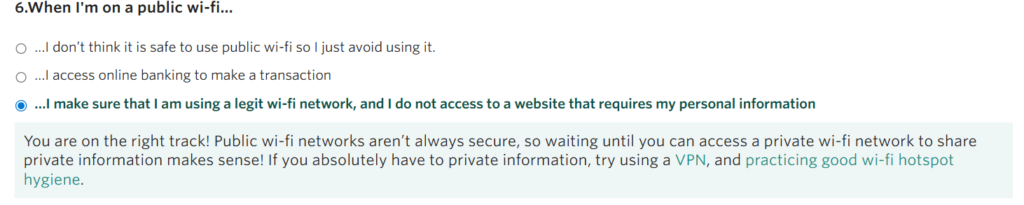
Question 6 from Privacy and Surveillance Quiz: Privacy and Surveillance Quiz – Digital Tattoo
The Government of Canada’s Get Cyber Safe website explains that browsing on public Wi-Fi can be riskier than using a private network. It recommends avoiding sensitive activities, such as accessing bank accounts or making purchases, while connected to public Wi-Fi (Government of Canada, 2020).
Building my Visitor and Resident app made me consider how I use the platforms that make up my digital identity and personal learning network (PLN). Doing this activity, I realized that the platforms I use are dispersed over the horizontal axis (Visitor versus Resident). The map also made me realize that personal and professional digital identities are hard to fully separate. Personal platforms like Instagram can still affect how others see me professionally, while LinkedIn also includes some personal self-expression.
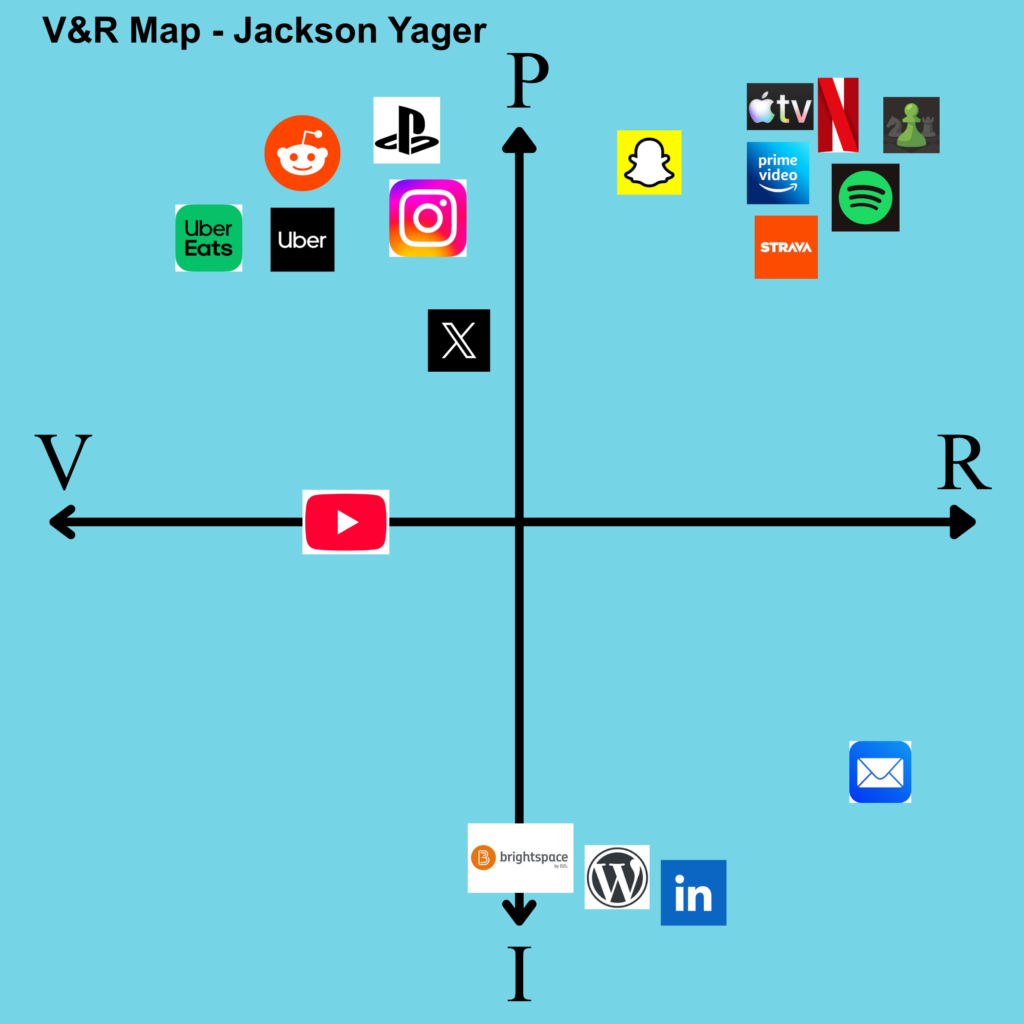
Map made on Canva: https://canva.link/t1o49u0oym10kd9
Shelley Moore’s youtube video https://youtu.be/PQgXBhPh5Zo?si=k9pOsUcEKf6xSIjN on The Evolution of Inclusion made me think about how inclusive my learning environments have been throughout my academic career. Moore explains how the way we treat individuals with intellectual disabilities in learning spaces has progressed from exclusion to segregation to integration to inclusion. Looking back my academic career so far, I can see how individuals with intellectual disabilities have been progressively more included. True inclusion means that learning environments are designed so that everyone can participate meaningfully and have access to the support they need.
The readings this week have made me realize that I could make an effort to create a more diverse PLN for myself. A diverse PLN is valuable because it helps me understand perspectives beyond my own. After graduating with a Health Information Science degree, I will likely be working in a healthcare setting where it is crucial to consider all perspectives to create valuable, culturally-safe healthcare. A PLN should be inclusive, but inclusion does not happen automatically. Clark and Aufderheide (2011) argue that public media platforms need to be accessible and representative of the whole population, and that extra effort is needed to include underserved users.
Social media can allow for better communication by making it easier to share resources, ask questions, and connect with people outside of one workplace. It can also help amplify voices that may not always be heard in traditional professional spaces. However, social media also creates challenges. Messages can be misunderstood or taken out of context which can be detrimental to the organization. In healthcare, this is especially important because workers need to think about professionalism, privacy, confidentiality, and organizational social media policies before posting.
References:
Clark, J., & Aufderheide, P. (2011). A New Vision for Public Media: Open, Dynamic, and Participatory. In Media and Social Justice (pp. 55–67). Palgrave Macmillan US. https://doi.org/10.1057/9780230119796_5
Five Moore Minutes. (2018, October 1). The Evolution of Inclusion: The past and future of education [Video recording]. https://www.youtube.com/watch?v=PQgXBhPh5Zo
Government of Canada, C. S. E. (2020, March 2). Public Wi-Fi. Get Cyber Safe. https://www.getcybersafe.gc.ca/en/secure-your-connections/public-wi-fi?utm_source=chatgpt.com
Moore, S., & Schnellert, L. (2016). One Without the Other: Stories of Unity Through Diversity and Inclusion. Portage & Main Press. http://ebookcentral.proquest.com/lib/uvic/detail.action?docID=4832579